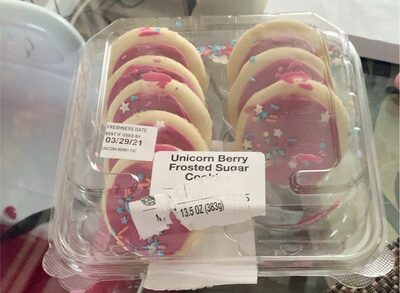
UNICORN BERRY FROSTED SUGAR COOKIES — Profile D | Nutrition facts · Wal-Mart Stores, Inc. | BetterBite
Wal-Mart Stores, Inc.
D
ProfileConcern
UNICORN BERRY FROSTED SUGAR COOKIES
Bakery & Breads USVerified
Label Serving
38 g
Barcode
078742443102
Data last verified: 1 Oct 2026
Important Disclaimer
BetterBite provides nutritional transparency insights based on publicly available data from regulatory databases (FDA, USDA, EFSA, WHO), published peer-reviewed research, and manufacturer-declared product information. This platform is designed for educational and informational purposes only.
The content displayed on this platform does not constitute medical advice, diagnosis, or treatment recommendations. Transparency scores, nutritional assessments, and ingredient analyses represent algorithmic interpretations of publicly available data and should not be used as a substitute for professional medical or nutritional guidance.
Individual dietary needs, allergies, and health conditions vary significantly. Always consult a qualified healthcare professional, registered dietitian, or physician before making dietary changes based on information found on this platform. Product formulations may change without notice — always verify information against current product labels.
AI Research Disclosure: Technical analysis and research patterns on this page are synthesized using BetterBite AI researchers.AI can make mistakes or provide incomplete insights.This technology aggregates data from scientific literature for informational assistance. Always verify findings against primary sources for critical dietary decisions.
Nutritional values transcribed from the product label. Actual values may vary.
% Daily Value
Share of an average adult's daily allowance in one serving (38 g) — the label's %RDA
Energy & macronutrients
Energy160 kcal8%
Total Fat6g8%
Saturated Fat2.5g13%
Trans Fat0gLow0%
Cholesterol4.94mgLow2%
Carbohydrates26g9%
Total Sugars16gHigh32%
Added Sugars16gHigh32%
Dietary Fiber0g0%
Protein1g2%
Sodium115mg5%
Minerals
Potassium0mg0%
Calcium0mg0%
Iron0.6mg3%
Remaining vitamins and trace minerals: US FDA Daily Values. Low = under 5% of a day in one portion · High = 20% or more. Reference values, not medical advice.
Ingredient Transparency
Tap any row · FDA, USDA, EFSA, WHO
24 / 33 researched · AI analyzing 9 more...
Ingredients — as printed on the label
SUGAR, BLEACHED ENRICHED FLOUR (WHEAT FLOUR, NIACIN, REDUCED IRON, THIAMINE MONONITRATE, RIBOFLAVIN, FOLIC ACID), MARGARINE (PALM OIL, WATER, SOYBEAN OIL, SALT, CONTAINS 2% OR LESS OF: MONO- AND DIGLYCERIDES, CALCIUM DISODIUM EDTA [PRESERVATIVE], ARTIFICIAL FLAVOR, ANNATTO EXTRACT [COLOR], VITAMIN A PALMITATE), EGGS, CONTAINS 2% OR LESS OF WATER, CORN STARCH, RICE FLOUR, LEAVENING (BAKING SODA, SODIUM ALUMINUM SULFATE, MONOCALCIUM PHOSPHATE), PALM KERNEL OIL, PALM OIL, MODIFIED CORN STARCH, POLYSORBATE 60, CITRIC ACID, SOY LECITHIN (EMULSIFIER), NONFAT MILK, CARRAGEENAN, CELLULOSE GUM, CARMINE (COLOR), NATURAL AND ARTIFICIAL FLAVORS, CONFECTIONER'S GLAZE, COLOR ADDED, SODIUM PROPIONATE (PRESERVATIVE), GUM ARABIC, BLUE 1, RED 3, YELLOW 5, YELLOW 6, GLUCOSE SYRUP, BLUE 2 LAKE, CARNAUBA WAX, RED 40.
Contains allergens: Margarine, Eggs, Nonfat Milk
1
Margarine
Synthetic
ModerateAllergen
Fat spread, structural agent in baking, and culinary medium
2
Bleached Enriched Flour
Low
Structuring agent, texture enhancer, and primary carbohydrate base for baked goods, pasta, and bread products.
3
Sugar
Moderate
Sweetener, texturizer, preservative, and browning agent
4
Eggs
LowAllergen
Protein source, emulsifier, binding agent, leavening agent, and structural component in baking and processed foods.
5
Corn Starch
INS 1405
No Notables
Thickening agent, stabilizer, and anti-caking agent in food products.
6
Water. Contains 2% Or Less Of Salt
Under Review
AI summary pending...
7
Rice Flour
No Notables
Thickener, texture agent, gluten-free baking flour, and coating agent
8
Leavening
No Notables
Texturizing agent / Leavening
9
Palm Kernel Oil
Moderate
Texturizer, fat source, and coating agent in confectionery, bakery items, and dairy alternatives.
10
Modified Corn Starch
E1422
No Notables
Stabilizer, thickener, and emulsifier in food manufacturing to improve texture and shelf-life stability.
11
Polysorbate 60
E435
Low
emulsifier, stabilizer, and dispersing agent
12
Palm Oil
Moderate
Structuring agent, frying oil, and textural modifier in baked goods, confectionery, and processed foods.
13
Soy Lecithin
E322
Low
Emulsifier, stabilizer, and releasing agent
14
Nonfat Milk
No NotablesAllergen
Used as a fluid beverage, ingredient in baking, dairy products, protein supplementation, and commercial food manufacturing for moisture and nutrition without added fat.
15
Citric Acid
E330
No Notables
Flavour enhancer, acidity regulator, and preservative
16
Cellulose Gum
E466
No Notables
Thickener, stabilizer, emulsifier, and texture modifier
17
Carrageenan
E407
Low
Thickener, stabilizer, and gelling agent in dairy, plant-based milks, and processed foods.
18
Carmine
Under Review
AI summary pending...
19
Color Added
Low
Colorant
20
Confectioner'S Glaze
Under Review
AI summary pending...
21
Natural And Artificial Flavor
Synthetic
No Notables
flavour
22
Sodium Propionate
Under Review
AI summary pending...
23
Gum Arabic
E414
No Notables
Stabilizer, emulsifier, thickening agent, and dietary fiber additive in beverages, confectionery, and baked goods.
24
Blue #1
Under Review
AI summary pending...
25
Yellow 6
Under Review
AI summary pending...
26
Yellow 5
E102
Low
Color additive
27
Red #3
Under Review
AI summary pending...
28
Carnauba Wax
E903
No Notables
Glazing agent, surface finishing agent, and moisture barrier
29
Blue 2 Lake
E132
Low
Coloring agent
30
Glucose Syrup
Moderate
Sweetener, texturizer, humectant, and anti-crystallizing agent in food products.
31
Red #40
E129
Low
Color additive
32
BLUE 1
Indexing with AI...
33
RED 3
Indexing with AI...
Ingredient
Concern
Function
Notes
1
Margarine
Synthetic
Allergen
⚠Moderate Concern
Fat spread, structural agent in baking, and culinary medium
Margarine is generally recognized as safe, though nutritional considerations vary based on the presence of specific fatty acid profiles and processing methods.
2
Bleached Enriched Flour
✓Low Concern
Structuring agent, texture enhancer, and primary carbohydrate base for baked goods, pasta, and bread products.
Enriched bleached flour is widely permitted and provides essential micronutrients through fortification, though it offers lower dietary fiber compared to whole grain alternatives.
3
Sugar
⚠Moderate Concern
Sweetener, texturizer, preservative, and browning agent
Sugar provides rapid energy but moderate consumption is recommended to align with established nutritional guidelines.
4
Eggs
Allergen
✓Low Concern
Protein source, emulsifier, binding agent, leavening agent, and structural component in baking and processed foods.
Eggs are a nutrient-dense food source recognized as a common allergen, requiring appropriate labeling for sensitive populations.
5
Corn Starch
INS 1405
✓No Notable Concerns
Thickening agent, stabilizer, and anti-caking agent in food products.
Corn starch is a standard food ingredient generally recognized as safe for consumption within normal dietary parameters.
6
Water. Contains 2% Or Less Of Salt
?Under Review
—
AI summary pending...
7
Rice Flour
✓No Notable Concerns
Thickener, texture agent, gluten-free baking flour, and coating agent
Rice flour is a well-tolerated, naturally gluten-free ingredient widely used for texture and baking, with considerations primarily related to its glycemic response profile when consumed in refined forms.
8
Leavening
✓No Notable Concerns
Texturizing agent / Leavening
Leavening agents are standard food ingredients used to create texture in baked products, with regulatory status permitting standard culinary and industrial applications.
9
Palm Kernel Oil
⚠Moderate Concern
Texturizer, fat source, and coating agent in confectionery, bakery items, and dairy alternatives.
Palm kernel oil contains high levels of saturated fats, meaning consumption patterns should align with broader dietary guidelines for lipid intake.
10
Modified Corn Starch
E1422
✓No Notable Concerns
Stabilizer, thickener, and emulsifier in food manufacturing to improve texture and shelf-life stability.
Modified corn starch is widely utilized as a food stabilizer and is generally recognized as safe by major regulatory bodies.
11
Polysorbate 60
E435
✓Low Concern
emulsifier, stabilizer, and dispersing agent
Polysorbate 60 is a widely permitted synthetic emulsifier with established regulatory safety margins for standard dietary consumption levels.
12
Palm Oil
⚠Moderate Concern
Structuring agent, frying oil, and textural modifier in baked goods, confectionery, and processed foods.
Palm oil is widely permitted and utilized for its stability, though consumption patterns high in its saturated fat content warrant moderation in accordance with standard dietary guidelines.
13
Soy Lecithin
E322
✓Low Concern
Emulsifier, stabilizer, and releasing agent
Soy lecithin is a commonly utilized emulsifier derived from soybeans, generally recognized as safe for the general population while requiring consideration for individuals with soy allergies.
14
Nonfat Milk
Allergen
✓No Notable Concerns
Used as a fluid beverage, ingredient in baking, dairy products, protein supplementation, and commercial food manufacturing for moisture and nutrition without added fat.
Nonfat milk is a widely consumed dairy ingredient providing essential proteins and micronutrients, suitable for the general population except those with lactose intolerance or milk protein allergies.
15
Citric Acid
E330
✓No Notable Concerns
Flavour enhancer, acidity regulator, and preservative
Citric acid is widely consumed naturally and commercially, generally recognized as safe for use in food production under standard regulatory guidelines.
16
Cellulose Gum
E466
✓No Notable Concerns
Thickener, stabilizer, emulsifier, and texture modifier
Cellulose gum is widely recognized as safe by global regulatory bodies, functioning primarily as an inert texturizer with minimal systemic absorption.
17
Carrageenan
E407
✓Low Concern
Thickener, stabilizer, and gelling agent in dairy, plant-based milks, and processed foods.
Carrageenan is a commonly used seaweed-derived stabilizer with established safety thresholds determined by international food safety authorities.
18
Carmine
?Under Review
—
AI summary pending...
19
Color Added
✓Low Concern
Colorant
Color added consists of pigments utilized for visual consistency, with regulatory bodies maintaining established safety thresholds for consumption.
20
Confectioner'S Glaze
?Under Review
—
AI summary pending...
21
Natural And Artificial Flavor
Synthetic
✓No Notable Concerns
flavour
Authorized flavorings are evaluated for safety by regulatory bodies and are generally recognized as safe for consumption within established usage limits.
22
Sodium Propionate
?Under Review
—
AI summary pending...
23
Gum Arabic
E414
✓No Notable Concerns
Stabilizer, emulsifier, thickening agent, and dietary fiber additive in beverages, confectionery, and baked goods.
Gum arabic is a naturally derived dietary fiber and stabilizing agent with a well-established safety profile for general consumption.
24
Blue #1
?Under Review
—
AI summary pending...
25
Yellow 6
?Under Review
—
AI summary pending...
26
Yellow 5
E102
✓Low Concern
Color additive
Yellow 5 is a widely permitted synthetic colorant with established acceptable daily intake levels, though monitored for specific individual sensitivities.
27
Red #3
?Under Review
—
AI summary pending...
28
Carnauba Wax
E903
✓No Notable Concerns
Glazing agent, surface finishing agent, and moisture barrier
Carnauba wax is a naturally derived substance recognized as safe for consumption within established regulatory limits.
29
Blue 2 Lake
E132
✓Low Concern
Coloring agent
Blue 2 Lake is an authorized synthetic color additive with established acceptable daily intake levels supported by international safety evaluations.
30
Glucose Syrup
⚠Moderate Concern
Sweetener, texturizer, humectant, and anti-crystallizing agent in food products.
Corn syrup provides readily available caloric energy and functional benefits in food preparation, though intake moderation aligns with broader dietary guidelines regarding refined carbohydrates.
31
Red #40
E129
✓Low Concern
Color additive
Red #40 is a widely utilized synthetic colorant with established regulatory safety limits and no recognized allergen profile.
32
BLUE 1
Indexing with AI...
33
RED 3
Indexing with AI...
Researching scientific toxicity & E-numbers for 2 remaining ingredients...
Live Syncing
Research sourced from FDA · USDA · EFSA · WHO · Peer-reviewed scientific literature. Informational only — not medical advice.
Disclaimer: These alternatives are algorithmically suggested based on nutritional indexing and ingredients. This does not constitute a commercial endorsement, criticism of the current product, or medical advice.